Wednesday, 2 March 2016

Africa and Europe's biggest solar grid in the desert of Morocco.

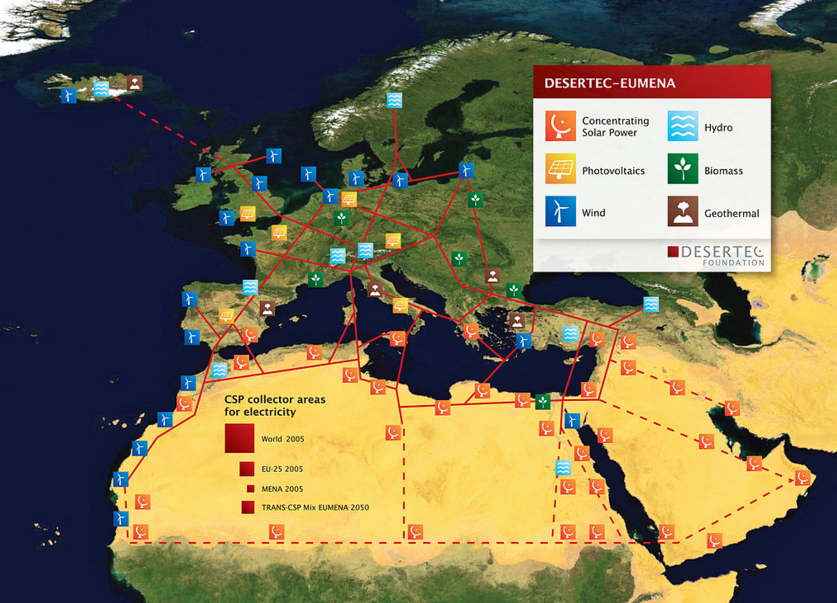
Despite huge wind and solar potential, it is too early to say when Morocco could begin exporting renewable electricity to Europe. from projects such as the $400 billion Desertec initiative. It is unclear whether the Desertec consortium's planned investment in solar thermal energy across North Africa could go into Morocco or how much power could eventually be exported to Europe. Desertec's plans are likely to need several years more of feasibility studies.


This week, Morocco switched on the first section of its new Ouarzazate solar power plant. The new installation already creates 160 megawatts of power and is expected to grow to cover 6000 acres by 2018 — making it the largest in the world.

Noor 1 will be joined over time by Noor 2 and 3 which are expected to be finished by 2018. When those sections come online, the whole plant will cover an areas of over 6000 acres, which is larger than the country’s capital city of Rabat. With the extra mirrors in place, the plant will generate 580 megawatts of electricity — enough to provide energy for 1.1 million people.


 The initial plan was to deliver the generated electricity to Europe but several partners pulled out. Interventions by the African Development Bank and the Moroccan government saved the project, though, and are now using it to meet Morocco’s own power demands. As of today, it will do just that.


  • Desertec is an important project for Germany. From the political point of view this initiative is meant to show Germany's strong commitment to promoting the use of renewable sources of energy and to supporting economic growth in African countries. Furthermore, this project is intended to support Germany’s concept of Energy Revolution which envisages increasing the share of renewable sources of energy in countries' energy balances, climate protection, heightened security of supplies and diversification of energy supply sources to Europe (made possible thanks to greater integration of African and European energy networks). Additionally, the Desertec project, which involves mainly German companies, was intended to be a profitable investment for Germany’s economy and aimed at strengthening Germany's reputation as the leader in the technology leader for renewable energy production.
In November 2009 Morocco announced a solar energy project worth $9 billion which officials said will account for 38 percent of the North African country's installed power generation by 2020. Funding would be from a mix of private and state capital. The ceremony was attended by U.S. Secretary of State Hillary Clinton and the Moroccan king.The project will involve five solar power generation sites across Morocco and will produce 2,000 megawatts of electricity by 2020. The project would add in terms of power generation the equivalent of the current electricity consumption of the country's commercial capital Casablanca. Germany has expressed its willingness to participate in the development of Morocco's solar energy project which the country has decided to carry out, as did the World Bank. Germany will also take part in the development of a water-desalination plant.
A net energy importer, Morocco launched the National Renewable Energy and Efficiency Plan in February 2008 to develop alternative energy to meet 15% of its domestic needs and increase the use of energy-saving methods. The plan is expected to create more than 40,000 jobs and stimulate over €4.5bn in investment by 2020. The National Plan for the Development of Solar Thermal Energy, formulated in 2001, aims to install 440,000 solar-powered water heaters by 2012, of which 235,000 are completed. The Moroccan government plans to produce 40% of its energy from renewable sources by 2020.
In 2008 Morocco announced plans for a new campus providing knowledge-based services to strengthen research and training in clean technology. The campus is part of a US$ 219 million clean energy industrial park being built in the eastern city of Oujda to support private sector investment as well as renewable energy companies. Building is under way, and the campus is expected to open by 2010.
Many initiatives are dedicated to renewable energy such as solar power plants, pumping stations, hydraulic turbines, waste recycling, water pumps, sea water desalination, air conditioning and solar water heaters. RE is also the focus of many economic and social programs, as in the case of rural electrification, where individual photovoltaic solar systems account for 7% of energy production.

Monday, 29 February 2016

The era of a new leadership is now


We often see the rise of self proclaimed leaders in our societies. Social networking sites has arrived with many possibilities. What is interesting is how collaborating in groups, people enable to access control over them. Most people never question, because it is easier not to question and opposition therefore fade away.


There were many responses to this issue, so I thought it would be interesting to unfold this topic a little more and share our experience, opinions and ideas here.


Those however with the ability to work with resources, assigning resources to task, establishing costs and adjust accurate planning are simply played off. Experienced project engineers and project managers see through this easily, when management practices and methodologies arise.


 To get a better understanding of this "leaders" can be very hard, since they mostly operate under the radar and with hardly any tracking record if at all. Discussions of various kinds are mostly vague and involved all kinds of shady people. Most of these shady characters have hidden agendas based on self enrichment. Some have become overnight traditional leaders due to their unemployment or laziness to seek for a credible decent job. It has become easier to go into politics, where no previous experience is required.


Manipulating the uneducated masses becomes their tasks. 


They usually use the sentiment of past sufferings under previous governments and circumstances that have kept people in weak financial and social circumstances. In other words, the people at risk are the one's who never had a life but simply exists on a daily basis through survival and under the poverty conditions. People living in poverty are easy to manipulate with selling them a dream for free. They are fond of cheap talk, because it is perhaps a distraction from their hunger pains or the shithole they living in.


Thanks to the opening of the Internet of whom the majority have little understanding.


Understanding APIs or Internet protocols is not relevant to them, rather to be in the spotlight. Unfortunately these "leaders" have no troubleshooting guide or guide to understand them better.

It is a pity that Facebook cater for "friends" only, maybe because Mark Z., can not distinguish among friends and acquaintances.


Some people of cheap material however do not care, whether they have meet someone in person, because now they can have easily 5 000 friends and exist inside the box and are to damn stupid to think outside the box. How boring life would be if all our views and opinions are the same?


What gives identity to a leader?

Is it how he identify his goals and objectives or is it how he/she coordinate different needs?


What I personally miss in these "leaders" are the simple indispensable leadership qualities, how they can be most effective, fairness, appreciation, commitment, inspire people, set examples, taken responsibility, showing initiation and the ability to show competence. A leader do not exclude you, he say things, plan things but most importantly do things.


Leaders have track records of building institutions and businesses.

Leaders are often misunderstood simply because some people don't understand priorities. As a leader you must take as often as possible self-assessment in terms of your strength and your personal area of weakness. If we do not address our personal shortcomings, we will simply steam role over the weak and uneducated poor masses. A low or uneducated person is a poor person.


Allow me to end with the quote of Dr. Maxwell “if you don’t have influence, you will never be able to lead others”.

Therefore leading without influence is like gathering water in a basket but with it you are limitless in your achievement.


There are several key points that I have left out on purpose, because I do not believe in spoon feeding. This of course is making me less passionate. Most people hate to think inside out or outside in. I trust this may serve as an eye opener and not as a public lecture.


The floor is now open for discussion. 

Thank you for your persistence and motivation to take time to read this.

Johan Hossayn van Wyk

Sunday, 28 February 2016

South Africa's Finance Minister Pravin Gordhan says he will take steps against attempts to discredit him

South Africa's Finance Minister Pravin Gordhan said on Friday he would take legal action to protect himself from what he called attempts to discredit him and the integrity of the National Treasury. Gordhan's statement followed a newspaper report which quoted sources as saying he had threatened to resign from cabinet after receiving a letter from the elite Hawks police unit questioning his knowledge of a suspected rogue unit at the revenue service.

 South African Minister of Finance, Mr. Pravin Gordhan was born 1949-4-12 in Durban, South Africa.

Pravin Gordhan is the Minister of Finance. He was the previous Minister of Cooperative Governance and Traditional Affairs. He is the former Commissioner of the South African Revenue Service as well as the former Chair of the World Customs Organisation.Pravin Gordhan has been appointed as the minister of finance, replacing David van Rooyen.

 (Reporting by Stella Mapenzauswa; Editing by James Macharia)

African Union will send monitors to Burundi

The African Union will send 100 human rights monitors and 100 military monitors to Burundi, South Africa's president said on Saturday after a trip to the tiny nation that is facing its worst crisis since a civil war ended a decade ago.
Photo: Evrard Ngendakumana 

Jacob Zuma, delivering a statement by a delegation of African leaders that he led, did not say when the monitors would arrive in Burundi, where more than 400 people have been killed since April. Zuma left Burundi after his remarks.

Photo: Evrard Ngendakumana 

The violence has rattled a region with a history of ethnic conflict. Burundi's civil war, which ended in 2005, largely pitted two ethnic groups against each other. Neighboring Rwanda was torn apart by genocide in 1994.


Western powers have urged Africans to act. The United States and European nations have withheld some aid to poor Burundi and taken other steps to try to put pressure on the government to resolve the crisis, but they say it has had little impact.


"We believe strongly that the solution to Burundi's political problems can be attained only through inclusive and peaceful dialogue," Zuma said in the statement, which also expressed "concerns" about the level of violence and killings.


The decision to send monitors suggests a compromise had been reached with Burundi's President Pierre Nkurunziza, who triggered the crisis in April when he announced a bid for a third term. He went on to win a disputed election in July, in the face of street protests and violent clashes.


The new initiative falls far short of the African Union's plan announced in December to send a 5,000-strong peacekeeping force, which Nkurunziza's government rejected.Details about the new mission were not immediately clear. Diplomats said other African monitors sent to Bujumbura last year had been stuck in their hotel unable to work because Burundi refused to sign a memorandum allowing them to operate.

The special forces sticks-convoy awaited President Jacob Zuma, with safety of passage. 

OPPOSITION URGES MORE MONITORS


Burundi's opposition said 200 monitors were not enough."They have to increase the number so they can cover the large part of the (country's) territory," said Thacien Sibomana, spokesman for the opposition UPRONA party. "They unfortunately remained silent on the peacekeepers deployment while people are continuously dying."


Burundi's government has previously said it was ready for dialogue, but opponents say it has set preconditions on who would attend and what could be discussed that made such discussions pointless.


Talks sponsored by nearby Uganda in December had been planned to continue in Tanzania in January. But the initiative stumbled at the start of the year when the government said it would not attend as some participants had been behind violence.For their part, opponents accuse government forces of targeting and killing members of the opposition.


The statement by African leaders said Uganda's President Yoweri Museveni would convene dialogue with "all important stakeholders as soon as possible". It did not say when.


(Writing by Edmund Blair; Editing by Gareth Jones)

Thursday, 10 October 2013

The silent political abuse of the people of colour.

Long forgotten by the "free media and press", the ever suffering are on the increase continuously in South Africa. The major political groups that are responsible for the abuse, are ANC & DA.

Most of the people who under the harsh abuse, hardly notice it, because it has become a way of live. Drugs and alcohol abuse are increasingly in most provinces and survival has become natural.

Most of the youth are uneducated and with no jobs. This creates a vacuum, that are mostly fill with crime, drugs, prostitution, alcohol and other subsistence abuse and are ever-worsening. Teenagers with hardly any education or working skills has been deprived from a future. This has cause chronic damage to families and societies at large.

In the squander for for wealth, pensioners and children are almost forgotten. This has created an education backlog and has destroy an entire generation of the youth. Economic activity has been left in the hands of commercial companies, and the rule is expected to last for another four hundred years. Chiefs, tribesmen, councillors and politicians came to constitute no more then a new class of government intermediaries  paid to ruthlessly and brutally transmit the puppet government of the Western world's orders.

The small educated elite that have been produced over the years are mostly preoccupied with their own status and seeking to gain more wealth for themselves. This has left the ever suffering communities in a total state of rejection and denial.

The profound dreams of a changing society are creating daily more and more misery, poverty and a greater unequal balance. Frustration and restlessness are on the increase and growing into corruption and all things leading to evil.
Selfishness has become a new way of life. Morals are fading away and culture values has become a myth. The bulk of the population has become loyal as the tide sweep away honour and dignity.

With no major development plans in sight, the youth are in a state of trance. Promises of over twenty years, has shown evidence that the reality on the ground is different. Greater diversity then ever before has been created over the last two decades, and hope seem to fade away altogether.

The dreams of our people have been turned into nightmares and living hell. The silent crisis will vanish into thin air, like the AIDS/HIV epidemic. What we see is a new generation of frustrated and impatient youth, seeking a way with violence and impatient force, because constitutional reform has become bogus and fraudulent.

®Khoranah Exx
©Khoranah Exx

Thursday, 3 October 2013

Happy unification day Germany.

 Today, I want to send a message of solidarity to the German people. I want to congratulate them, on their twenty third anniversary of their unification.

It is good to look back, and never forget the past. As long as we never forget our past, we will always be aware of our future dreams.

Germany unlike South Africa (Hottentot-land) and Namibia (Hottentot-land) today, was the most envied country in the world, for his economic model twenty years after World War II. Most countries thought then, that Germany would become the biggest client in terms of a USA welfare State.

They were all proved to be so wrong. Most countries did not believe in an economic miracle for Germany. We can argue the Marshall Plan or any other economic factors that have contribute to the cause of the miracle, if we want to be politically correct. We can go back to the 1948 price controls for solid arguments. We can chose to go back to Roosevelt and Churchill whom also imposed price controls and rationing on the German people. This will keep us moving in circles forever and ever.

However it may sound today, will not change the course of history, neither will it change the November 1945 Allied Control Authority by countries such as France, Great Britain or the Soviet Union at the time. Nor will it change the food shortages that the German people were living off, in a time of severe food shortages for the German people.

Though we have to admit the true reality of suffering at the time before and after the war (WWII). 

The social-free market system that has been created by the economist Eucken of the University of Freiburg and other intellectuals that represented a resistance movement, requiring extremely great personal courage and fearless independence of mind. Something that are lacked in our societies of the Sub-Saharan African continent, or how it was referred to Hottentot-land or Bushmen-land in derogative terms. These derogative terms gave identity to us as Korana, Bosluis Baster, Namaqua, Basters, Griqua, and other known today as Khoi people.


To the Khoi people, you must remember one thing has been made clear by the sons of the Nguni traders of old. They said they will die fighting. Fair enough, we will continue to live as a people that once entered through the Kalahari in Botswana and Angola today. Our peoples traces are still visible as well as the small groups that exist there today.

Happy unification day Germany!
 
©Khoranah Exx
ps.  I have not any © of any of the photos. The Nama stap children © belongs to Shaul Blackboy as far as I am concerned.